Successfully navigating the dynamic landscape of modern business requires a deep understanding of both sales and business development. These two disciplines, while distinct, are inextricably linked, working in tandem to drive growth and achieve organizational objectives. This exploration delves into the core principles of each, highlighting their key differences, effective integration strategies, and the crucial role of ethical practices.
We’ll examine practical strategies, essential skill sets, and the importance of continuous improvement through coaching and strategic planning.
From crafting compelling business plans and identifying lucrative market opportunities to mastering sales techniques and building enduring customer relationships, this comprehensive guide provides a roadmap for success. We’ll also touch upon securing funding, navigating business travel, and the critical role of ethical conduct in fostering sustainable growth.
Defining Sales and Business Development
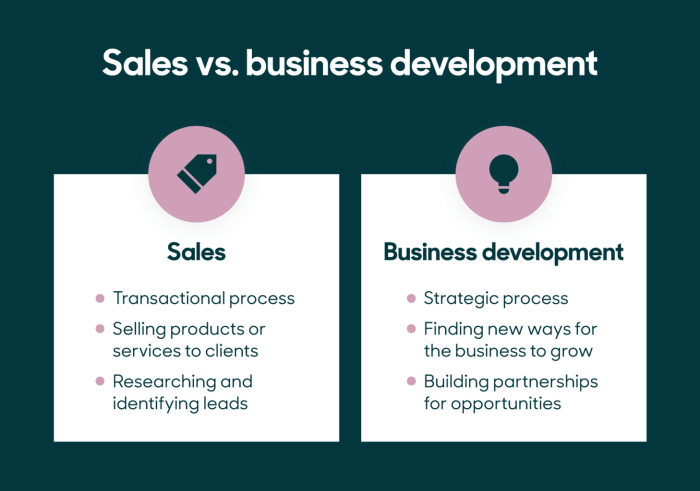
Sales and business development are often conflated, but they represent distinct yet complementary functions within an organization. While both contribute to revenue generation, their approaches, goals, and required skill sets differ significantly. Understanding these differences is crucial for building a high-performing team.Sales focuses on closing deals and generating immediate revenue. Business development, on the other hand, concentrates on long-term growth by identifying and cultivating new opportunities.
It’s a strategic function aimed at expanding the market reach and building sustainable competitive advantages.
Core Differences Between Sales and Business Development
Sales and business development operate on different timelines and with different objectives. Sales teams are focused on short-term wins, directly converting leads into paying customers. Their efforts are measurable through immediate sales figures and conversion rates. Business development, conversely, focuses on the long-term, building relationships and creating new market opportunities that may not yield immediate revenue. Success is measured through broader metrics such as market share expansion, strategic partnerships, and brand awareness.
For example, a sales team might focus on closing deals with existing clients, while a business development team might focus on developing new product lines or entering new geographic markets.
Examples of Successful Strategies Integrating Sales and Business Development
Effective organizations recognize the synergy between sales and business development. Successful integration strategies often involve close collaboration and shared information. For example, business development teams can provide sales teams with insights into emerging market trends and potential new client segments. Conversely, sales teams can provide valuable feedback on customer needs and preferences, informing the business development team’s strategic planning.
A successful example is Salesforce, which integrates sales and business development activities through a shared CRM system and collaborative processes, ensuring alignment and optimized lead generation. This allows for seamless hand-off of qualified leads from business development to sales, maximizing conversion rates. Another example could be a tech startup leveraging business development to secure strategic partnerships that open up new sales channels and significantly increase their market reach.
Comparison of Skill Sets
The skill sets required for sales and business development roles differ substantially. Sales professionals require strong communication, persuasion, and closing skills. They are adept at building rapport, handling objections, and negotiating deals. They need to be highly results-oriented and comfortable working under pressure to meet sales targets. Business development professionals, conversely, require strong strategic thinking, market analysis, and relationship-building skills.
They need to be adept at identifying opportunities, conducting market research, and developing long-term strategies. While both roles benefit from strong communication skills, the nature of communication differs; sales communication is transactional, while business development communication is more relational and strategic. For example, a sales representative needs strong presentation skills to pitch products, while a business development manager requires strong networking skills to build relationships with potential partners.
Finally, data analysis skills are important for both, but their application differs: Sales utilizes data to track performance and identify trends in sales, while business development uses data to assess market opportunities and evaluate potential partnerships.
Business Development Strategies
Effective business development is crucial for the growth and sustainability of any company, particularly in the dynamic tech landscape. A well-defined strategy, coupled with consistent execution, can significantly impact a startup’s trajectory, fostering market penetration and long-term success. This section will explore key strategies, illustrating their application through a hypothetical tech startup example.
Business Development Plan for a Hypothetical Tech Startup
Let’s consider “InnovateTech,” a hypothetical startup developing AI-powered customer service software. Their business development plan would encompass several key areas: market analysis identifying target customer segments (e.g., small to medium-sized businesses lacking robust customer support), a detailed go-to-market strategy focusing on online marketing, strategic partnerships with complementary tech companies (e.g., CRM providers), a sales process outlining lead generation, qualification, and closing, and a budget allocation for marketing, sales, and partnership development.
Regular monitoring and adjustment of the plan based on performance data are essential. Key milestones, such as securing a specific number of clients or achieving a certain revenue target within a set timeframe, would be defined and tracked.
The Importance of Market Research in Business Development
Market research is foundational to successful business development. It provides crucial insights into the target market, including customer needs, preferences, buying behaviors, competitive landscape, and market size. For InnovateTech, thorough market research would involve surveys, competitor analysis, and focus groups to understand the challenges faced by businesses in managing customer service, the features most valued in customer service software, and the pricing sensitivity of potential clients.
This information informs product development, marketing messaging, and sales strategies, maximizing the likelihood of market acceptance and revenue generation. Without it, the risk of developing a product that doesn’t meet market needs is significantly increased.
A Step-by-Step Guide for Identifying and Pursuing New Business Opportunities
Identifying and capitalizing on new business opportunities requires a systematic approach. First, InnovateTech would continuously monitor industry trends and technological advancements to identify emerging needs. Second, they would analyze their existing customer base for unmet needs or potential upselling opportunities. Third, they would actively network and attend industry events to identify potential partnerships and collaborations. Fourth, they would proactively explore new market segments or geographic regions.
Fifth, they would develop tailored solutions for each identified opportunity, focusing on value proposition and competitive differentiation. Finally, they would track the performance of each initiative, iterating and adapting as needed.
Key Performance Indicators (KPIs) for Measuring Business Development Success
Tracking relevant KPIs is critical for assessing the effectiveness of business development efforts. For InnovateTech, key KPIs could include: number of qualified leads generated, conversion rate from lead to customer, customer acquisition cost (CAC), average revenue per customer (ARPU), customer churn rate, and lifetime value (LTV) of a customer. Monitoring these metrics allows for timely adjustments to strategies, ensuring resources are allocated effectively and maximizing return on investment (ROI).
Comparing these KPIs against industry benchmarks provides valuable context and highlights areas for improvement. For example, a high CAC compared to the industry average might indicate a need to refine the lead generation strategy or explore more cost-effective marketing channels.
Sales Techniques and Processes
Effective sales techniques and processes are crucial for achieving business goals. A well-defined sales process streamlines interactions, increases efficiency, and improves the chances of closing deals. Understanding the various stages and employing effective strategies at each point is key to success.
Stages of a Typical Sales Process
The sales process typically involves several distinct stages, each requiring specific strategies and techniques. A consistent approach across these stages ensures a smooth customer journey and maximizes conversion rates. While variations exist depending on the industry and product complexity, a common framework includes lead generation, qualification, presentation, handling objections, closing, and follow-up.
- Lead Generation: Identifying and attracting potential customers through various channels like marketing campaigns, networking, and referrals. This stage focuses on creating awareness and generating interest.
- Lead Qualification: Assessing the potential of leads based on factors like budget, authority, need, and timeline (BANT). This ensures sales efforts are focused on qualified prospects with a high probability of conversion.
- Presentation: Presenting the product or service to the prospect, highlighting its value proposition and addressing their specific needs. This stage involves showcasing the benefits and demonstrating how the solution solves their problems.
- Handling Objections: Addressing concerns and reservations expressed by the prospect. Effective objection handling requires active listening, empathy, and providing clear, concise answers.
- Closing: Securing the commitment from the prospect to make a purchase. This stage requires skillful negotiation and a clear understanding of the prospect’s decision-making process.
- Follow-up: Maintaining contact with the customer after the sale to ensure satisfaction and build long-term relationships. This includes providing support, addressing any issues, and fostering loyalty.
Effective Objection Handling Techniques
Prospective clients often raise objections during the sales process. Addressing these concerns effectively is crucial for closing deals. Effective techniques include active listening, empathizing with the customer’s perspective, and providing solutions tailored to their concerns. For example, if a customer objects to the price, you might highlight the long-term value and return on investment, or explore alternative pricing options.
Similarly, addressing concerns about product features or delivery timelines requires a clear, factual response and potential solutions.
Examples of Successful Sales Scripts
Sales scripts can be tailored to different customer segments to enhance effectiveness. For example, a script for a high-value, complex sale might emphasize detailed explanations and a collaborative approach, while a script for a low-value, quick sale might prioritize brevity and clarity. A successful script for a small business owner might focus on cost savings and increased efficiency, while a script for a large corporation might highlight scalability and integration capabilities.
These scripts should be adaptable to individual customer needs and conversation flow, not rigidly followed.
Best Practices for Building and Maintaining Strong Customer Relationships
Strong customer relationships are essential for long-term success. Building trust and rapport is crucial, which involves active listening, understanding customer needs, and providing excellent service. Regular communication, personalized interactions, and addressing customer concerns promptly are vital. Proactive follow-up, seeking feedback, and showing appreciation contribute to building loyalty and fostering advocacy. For example, a simple thank-you note after a purchase, or a follow-up call to check on satisfaction, can go a long way in building strong customer relationships.
Furthermore, a loyalty program or exclusive offers can reinforce the relationship and encourage repeat business.
Business Ethics in Sales and Development
Building strong, sustainable business relationships requires more than just closing deals; it necessitates a firm commitment to ethical conduct. A reputation for integrity is invaluable, fostering trust with clients, partners, and employees alike. Conversely, unethical practices can severely damage a company’s image and ultimately hinder its long-term success. This section examines the ethical considerations crucial for sales and business development teams.
Ethical Implications of Aggressive Sales Tactics
Aggressive sales tactics, while sometimes perceived as effective in the short term, often carry significant ethical implications. High-pressure sales techniques, misleading claims about products or services, and the manipulation of customer information can severely damage a company’s reputation and erode customer trust. For example, exaggerating product benefits or using fear-mongering tactics to pressure a sale not only violates ethical standards but also risks legal repercussions.
Building relationships based on trust and mutual respect is far more sustainable than relying on aggressive, potentially deceptive methods. Focusing on providing genuine value and meeting customer needs is a more ethical and ultimately more profitable long-term strategy.
Potential Conflicts of Interest in Business Development Activities
Conflicts of interest represent a significant ethical challenge in business development. These situations arise when an individual’s personal interests or relationships could potentially influence their professional judgment or actions. For instance, a business development manager negotiating a deal with a company where a close relative is employed could be perceived as a conflict of interest, even if no direct favoritism is intended.
Transparency and disclosure are crucial in mitigating these risks. Establishing clear guidelines on how to identify, manage, and report potential conflicts of interest is essential for maintaining ethical conduct. Companies should have robust internal policies that address these issues, including mechanisms for reporting potential conflicts and ensuring impartial decision-making.
Importance of Transparency and Honesty in All Business Interactions
Transparency and honesty form the bedrock of ethical business practices. Open communication, clear and accurate information sharing, and a commitment to truthfulness build trust and foster strong relationships. Hiding crucial information, making false promises, or engaging in deceptive marketing tactics can severely damage a company’s reputation and create long-term damage. Transparency builds trust, leading to stronger customer relationships, enhanced employee morale, and a more positive overall business environment.
Honesty in all interactions, from initial contact with a potential client to the final stages of a deal, is paramount for building lasting ethical business practices.
Code of Conduct for a Sales and Business Development Team
A comprehensive code of conduct is essential for guiding ethical behavior within a sales and business development team. This code should clearly articulate expectations regarding honesty, integrity, transparency, and respect for customers and colleagues. It should explicitly prohibit deceptive marketing practices, pressure tactics, and conflicts of interest. The code should also Artikel procedures for reporting ethical violations and mechanisms for addressing complaints.
Regular training and reinforcement of this code of conduct are essential to ensure its effectiveness. Examples of specific clauses within such a code could include: a commitment to truthful advertising, a prohibition against sharing confidential information, a policy on handling gifts and gratuities, and a clear process for reporting unethical behavior. This code should be accessible to all team members and consistently enforced to ensure a culture of ethical conduct.
The Role of Business Coaching
Business coaching plays a vital role in boosting sales performance and enhancing business development capabilities. By providing personalized guidance and support, coaches help individuals and teams overcome obstacles, refine their strategies, and ultimately achieve greater success. This targeted approach leads to significant improvements in both individual and organizational outcomes.Business coaching offers a structured framework for continuous improvement, addressing specific skill gaps and fostering a growth mindset within the sales and business development teams.
It moves beyond simple training, offering personalized mentorship and accountability to drive sustainable change.
Improving Sales Performance Through Coaching
Effective coaching techniques directly translate into improved sales performance. Coaches work with salespeople to identify and address weaknesses in their sales process, from prospecting and qualifying leads to closing deals and managing customer relationships. This often involves analyzing sales data to pinpoint areas for improvement and developing customized strategies to overcome specific challenges. For example, a coach might work with a salesperson struggling with closing deals by helping them refine their negotiation skills and objection handling techniques.
Another example could involve helping a salesperson improve their lead qualification process to focus their efforts on high-potential prospects, thus increasing their conversion rate.
Coaching Techniques to Enhance Business Development Skills
Several coaching techniques are particularly effective in improving business development skills. These techniques often involve a combination of observation, feedback, and goal setting. For instance, role-playing scenarios can help individuals practice their communication and negotiation skills in a safe and supportive environment. Behavioral coaching focuses on identifying and modifying unproductive behaviors that hinder business development efforts. Furthermore, strategic planning sessions can help individuals develop clear goals and actionable plans to achieve their business development objectives.
Goal setting, using the SMART framework (Specific, Measurable, Achievable, Relevant, Time-bound), provides a clear roadmap for progress and accountability.
Implementing a Business Coaching Program
Implementing a successful business coaching program requires careful planning and execution. A detailed plan should include defining clear objectives, identifying coaching needs, selecting qualified coaches, establishing a coaching structure, and implementing a robust evaluation process. The initial phase involves a thorough assessment of the sales team’s strengths and weaknesses to determine the specific coaching needs. Next, the organization should select experienced and qualified coaches who possess the necessary expertise and skills to work with the team.
The coaching structure needs to be clearly defined, specifying the frequency, duration, and format of coaching sessions. Finally, a comprehensive evaluation system should be implemented to track progress, measure the impact of the program, and make necessary adjustments. For example, regular feedback sessions with both coaches and team members, coupled with data analysis of sales performance, can provide valuable insights into the program’s effectiveness.
Benefits of Investing in Professional Business Coaching
Investing in professional business coaching for sales teams yields numerous benefits. Increased sales revenue is a direct outcome, as coaching enhances sales skills and productivity. Improved employee morale and retention are also significant advantages; personalized support and development opportunities foster a positive and engaging work environment. Moreover, coaching cultivates a culture of continuous learning and improvement within the organization, leading to long-term sustainable growth.
A measurable return on investment (ROI) can be achieved through increased sales, improved efficiency, and reduced employee turnover. Companies can track key performance indicators (KPIs) such as sales conversion rates, average deal size, and customer satisfaction scores to demonstrate the positive impact of the coaching program.
Securing Funding
Securing sufficient funding is crucial for the survival and growth of any new business. Understanding the various funding options available, coupled with a well-structured financial plan, significantly increases the chances of securing the necessary capital. This section explores different loan types, compares popular business models, and Artikels the creation of a comprehensive financial plan, along with the loan application process.
Types of Business Loans Available to Startups
Startups have access to a range of loan options, each with its own eligibility criteria and terms. These loans can be broadly categorized based on their purpose, repayment terms, and the type of lender. Choosing the right loan depends heavily on the business’s stage of development, financial health, and long-term goals.
- Small Business Administration (SBA) Loans: These government-backed loans offer favorable terms, including lower interest rates and longer repayment periods, making them attractive to startups. Eligibility is determined by the SBA, and lenders participate in the program.
- Term Loans: These are fixed-amount loans with a predetermined repayment schedule. They offer predictable payments but may require collateral.
- Lines of Credit: A line of credit provides access to funds up to a pre-approved limit, allowing businesses to borrow and repay as needed. This flexibility is beneficial for managing cash flow fluctuations.
- Microloans: Smaller loans, typically under $50,000, often provided by non-profit organizations or community development financial institutions (CDFIs). These are designed to support very small businesses and entrepreneurs.
- Equipment Financing: Loans specifically for purchasing equipment, where the equipment itself serves as collateral. This can be a good option for businesses needing specialized tools or machinery.
Comparison of Business Models: Subscription, Freemium, and Franchise
Different business models dictate revenue streams and operational structures. Understanding the strengths and weaknesses of each is crucial for selecting the most suitable approach.
| Model | Description | Advantages | Disadvantages |
|---|---|---|---|
| Subscription | Recurring payments for ongoing access to a product or service. | Predictable revenue stream, fosters customer loyalty. | Requires consistent value delivery, customer churn can impact revenue. |
| Freemium | Offers a basic product or service for free, with premium features available for a fee. | Attracts a large user base, potential for high-value conversions. | Requires a strong free offering, monetization can be challenging. |
| Franchise | Licensing a business model and brand to independent operators. | Rapid expansion potential, leveraging established brand recognition. | Franchise fees and royalties, maintaining brand consistency. |
Designing a Comprehensive Financial Plan
A comprehensive financial plan is essential for securing funding and managing the business effectively. It should include realistic revenue projections, detailed expense budgets, and a clear funding request.
- Revenue Projections: Based on market research, pricing strategy, and sales forecasts. Consider various scenarios (best-case, worst-case, and most likely). For example, a new coffee shop might project monthly revenue based on estimated customer traffic and average order value.
- Expense Budgets: Include all anticipated costs, such as rent, salaries, utilities, marketing, and supplies. A detailed breakdown of expenses ensures accurate financial planning. A software company, for instance, would budget for salaries of developers, marketing expenses, and server costs.
- Funding Request: Clearly state the amount of funding needed, its intended use, and the proposed repayment plan. This section should justify the funding request based on the financial projections and business plan.
Applying for a Small Business Loan
The application process for a small business loan typically involves several steps, from preparing the necessary documentation to negotiating loan terms. Thorough preparation and attention to detail are crucial for a successful application.
- Check Credit Score and Report: Lenders review credit history, so addressing any issues beforehand is crucial.
- Develop a Business Plan: A detailed business plan outlining the business model, market analysis, financial projections, and management team is essential.
- Gather Financial Documents: Prepare tax returns, bank statements, profit and loss statements, and balance sheets. These demonstrate financial stability and track record.
- Choose a Lender: Research different lenders and compare their offerings, including interest rates, fees, and repayment terms.
- Complete the Loan Application: Accurately and completely fill out the loan application form, providing all necessary supporting documentation.
- Negotiate Loan Terms: Discuss and negotiate the loan terms, including interest rate, repayment schedule, and any collateral requirements.
Strategic Planning and Business Travel
Strategic planning and effective business travel are crucial for the success of any sales and business development operation. A well-defined plan, coupled with efficient travel management, can significantly improve lead generation, client relationship building, and overall revenue growth. This section will Artikel key aspects of integrating strategic planning with business travel for optimal results.
Creating a Strategic Business Plan
A strategic business plan provides a roadmap for long-term growth. It should define clear, measurable, achievable, relevant, and time-bound (SMART) goals. For example, a goal might be to increase sales by 20% within the next fiscal year. This goal would then be broken down into smaller, more manageable objectives, such as expanding into a new market segment or launching a new product line.
The plan should also identify key performance indicators (KPIs) to track progress towards these objectives. Regular review and adaptation of the plan based on market conditions and performance data is essential.
Developing a Comprehensive Marketing Strategy
A robust marketing strategy is vital for reaching target audiences. This involves identifying ideal customer profiles (ICPs), understanding their needs and preferences, and developing targeted marketing campaigns across various channels. This could include digital marketing (, social media, email marketing), content marketing (blog posts, white papers, webinars), and traditional marketing methods (print advertising, trade shows). The strategy should also Artikel a clear budget allocation and a system for measuring the return on investment (ROI) of each marketing activity.
For instance, a company targeting small businesses might utilize LinkedIn advertising and industry-specific content marketing.
Organizing a Business Trip Itinerary
A detailed itinerary is essential for maximizing the productivity of a business trip. It should include all scheduled meetings, travel arrangements (flights, accommodation, transportation), and a budget for expenses. The itinerary should be meticulously planned to minimize wasted time and maximize face-to-face interactions with potential clients or partners. Contingency plans should also be included to account for unexpected delays or changes in schedule.
For example, a trip to attend a conference might include pre-scheduled meetings with potential clients before and after the conference sessions, with built-in buffer time between events.
Effective Communication During Business Travel
Effective communication is paramount during business travel. This involves clear and concise communication with colleagues, clients, and partners before, during, and after the trip. Regular updates on progress and any unforeseen issues should be communicated promptly. Utilizing various communication tools, such as email, instant messaging, and video conferencing, ensures seamless connectivity and efficient information sharing. For example, sending a pre-trip email outlining the agenda and expected outcomes of each meeting helps set expectations and ensures everyone is on the same page.
Illustrative Examples (Use HTML Table)
Successful business development hinges on strategic planning and effective execution. The following examples showcase how different strategies, when targeted correctly, can yield significant results. Analyzing these case studies provides valuable insights into replicable approaches for growth.
The table below presents three distinct business development strategies, highlighting their target markets, implementation methods, and the achieved outcomes. Each example illustrates a different approach to achieving business goals, emphasizing the importance of tailoring strategies to specific contexts.
Successful Business Development Strategies
| Strategy | Target Market | Implementation | Results |
|---|---|---|---|
| Strategic Partnerships | Small-to-medium sized businesses (SMBs) in the technology sector lacking in-house marketing expertise. | Identified and collaborated with a complementary technology company. Jointly developed a co-marketing campaign featuring webinars, case studies, and shared content marketing. Leveraged each company’s existing customer base. | Increased brand awareness by 40%, generated 25% more qualified leads, and secured 15% higher conversion rates within six months. |
| Content Marketing & Optimization | Professionals aged 25-45 interested in personal finance and investment strategies. | Created high-quality blog posts, infographics, and videos focusing on relevant s. Implemented a comprehensive strategy to improve search engine rankings. Established a strong social media presence to increase engagement and reach. | Experienced a 60% increase in organic website traffic, a 30% rise in lead generation, and a 20% boost in customer acquisition within one year. |
| Direct Sales and Account-Based Marketing (ABM) | Large enterprise clients in the healthcare industry requiring specialized software solutions. | Developed a targeted sales strategy focused on key decision-makers within prioritized accounts. Used personalized outreach, including tailored presentations and demonstrations, to showcase the software’s unique value proposition. Built strong relationships with key stakeholders. | Secured three major enterprise contracts, resulting in a 75% increase in annual recurring revenue and a significant expansion of market share within the target sector. |
Sales Process Flowchart (Use Blockquotes)
A well-defined sales process is crucial for consistent revenue generation and improved customer relationships. A visual representation, like a flowchart, can significantly aid in understanding and managing each stage effectively. The following flowchart Artikels a typical sales process, from initial contact to long-term customer retention.A successful sales process isn’t rigid; it adapts to specific industries, products, and customer interactions.
However, this example provides a solid foundation for building your own tailored process.
Sales Process Stages
Prospecting and Qualification: This initial stage involves identifying potential customers who align with your ideal customer profile (ICP). This might include researching leads, networking, or utilizing marketing-generated leads. The key is to qualify leads to ensure they have the need, budget, and authority to make a purchase.
Initial Contact and Needs Discovery: Once potential customers are identified, the next step is to make initial contact. This could be through a phone call, email, or social media message. The goal is to build rapport and understand their needs and pain points. Active listening is crucial here.
Presentation and Proposal: Based on the needs discovered, you’ll present your product or service, highlighting its benefits and how it addresses the customer’s challenges. A tailored proposal, outlining pricing and terms, should be provided.
Handling Objections and Negotiation: Customers often have concerns or objections. Addressing these professionally and empathetically is key. This stage often involves negotiation to reach a mutually agreeable solution.
Closing the Deal: This is the point where the customer commits to a purchase. A clear and concise closing process, along with appropriate documentation, is essential.
Onboarding and Implementation: Once the sale is closed, onboarding the customer is vital. This involves guiding them through the implementation process, ensuring they understand how to use your product or service effectively.
Customer Retention and Relationship Management: This final stage focuses on maintaining a long-term relationship with the customer. This includes providing excellent support, seeking feedback, and proactively identifying opportunities for upselling or cross-selling.
In conclusion, mastering both sales and business development is paramount for sustainable business growth. By understanding the nuances of each discipline, integrating effective strategies, and prioritizing ethical practices, organizations can unlock their full potential. Continuous learning, strategic planning, and a commitment to building strong customer relationships are key components of long-term success in this ever-evolving business environment. The journey may be challenging, but the rewards of a well-defined and ethically sound approach are substantial.
Answers to Common Questions
What is the difference between a sales lead and a marketing lead?
A marketing lead is someone who has shown interest in your product or service through marketing efforts (e.g., website visit, downloaded content). A sales lead is a marketing lead who has been qualified as a potential customer with a high likelihood of conversion.
How can I improve my sales closing rate?
Focus on understanding customer needs, addressing objections effectively, building rapport, and providing clear value propositions. Regularly review and refine your sales process based on performance data.
What are some common business development pitfalls to avoid?
Ignoring market research, neglecting customer feedback, failing to adapt to changing market conditions, and focusing solely on short-term gains are common pitfalls.
How important is networking in business development?
Networking is crucial. It helps build relationships, identify opportunities, and gain valuable insights. Active participation in industry events and online communities is essential.