
The digital marketplace thrives on innovative e-commerce business models. From the familiar B2C giants to niche B2B platforms and the ever-evolving C2C marketplaces, understanding the nuances of these models is crucial for success. This exploration delves into the core components of effective e-commerce strategies, examining revenue generation, marketing tactics, logistical challenges, and ethical considerations. We’ll navigate the complexities of choosing the right model, building a sustainable business, and adapting to the ever-shifting landscape of online commerce.
This guide offers a practical framework for navigating the complexities of the e-commerce world, providing insights into various models, revenue strategies, marketing approaches, and operational considerations. We will explore the essential elements of building a thriving online business, from defining your target audience and selecting appropriate revenue streams to mastering efficient logistics and maintaining ethical practices. The aim is to empower you with the knowledge and tools necessary to succeed in the dynamic realm of e-commerce.
Defining the E-commerce Business Model
E-commerce, the buying and selling of goods or services over the internet, encompasses a diverse range of business models, each with its own unique characteristics and challenges. Understanding these models is crucial for businesses aiming to thrive in the dynamic digital marketplace. A successful e-commerce business model requires a strong foundation built upon several key components, including a clear value proposition, efficient logistics and fulfillment, robust marketing and customer service, and a secure and user-friendly online platform.
Core Components of a Successful E-commerce Business Model
A thriving e-commerce business requires a synergistic interplay of several essential components. A compelling value proposition, clearly articulating the unique benefits offered to customers, is paramount. This proposition should differentiate the business from competitors and resonate with the target audience. Efficient logistics and fulfillment, ensuring timely and reliable delivery of products, are equally crucial for customer satisfaction.
A strong marketing strategy, effectively reaching and engaging the target market, is needed to drive traffic and sales. Finally, exceptional customer service, addressing customer inquiries and resolving issues promptly and professionally, fosters loyalty and positive word-of-mouth referrals. A secure and user-friendly online platform, providing a seamless and enjoyable shopping experience, is the foundation upon which all these elements rest.
Differences Between B2B, B2C, and C2C E-commerce Models
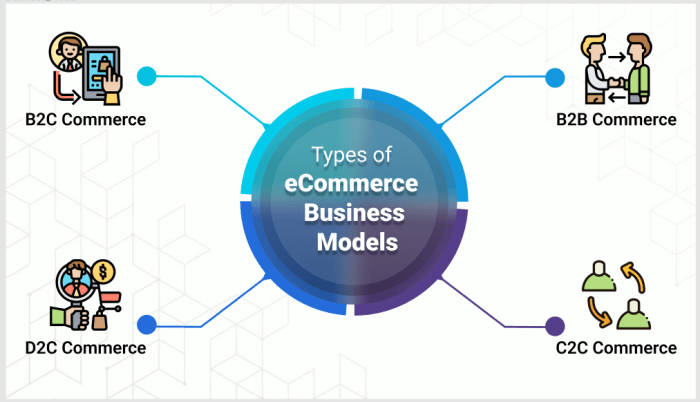
The e-commerce landscape is segmented into three primary models: Business-to-Business (B2B), Business-to-Consumer (B2C), and Consumer-to-Consumer (C2C). B2B e-commerce involves transactions between businesses, often characterized by large orders, complex negotiations, and long-term relationships. Examples include platforms facilitating wholesale purchases or supplying raw materials. B2C e-commerce focuses on transactions between businesses and individual consumers, emphasizing convenience, personalized experiences, and rapid delivery.
Amazon and Etsy are prominent examples of B2C platforms. C2C e-commerce involves transactions directly between consumers, often facilitated by online marketplaces that connect buyers and sellers. eBay is a classic example of a C2C platform. These models differ significantly in their target audience, marketing strategies, and operational requirements.
Examples of Innovative E-commerce Business Models and Their Strategies
Several innovative e-commerce models are disrupting traditional business practices. Subscription boxes, delivering curated products regularly to subscribers, leverage recurring revenue streams and foster customer loyalty. Examples include Birchbox (beauty products) and Dollar Shave Club (razors). Direct-to-consumer (DTC) brands, cutting out intermediaries and selling directly to consumers, offer greater control over branding and pricing. Warby Parker (eyeglasses) and Casper (mattresses) are successful DTC examples.
Personalized e-commerce, leveraging data to offer tailored product recommendations and experiences, enhances customer engagement and increases sales. Amazon’s recommendation engine is a prime example of this strategy. These models demonstrate the potential for creativity and innovation in the e-commerce space.
Comparative Table of E-commerce Business Models
| Model Type | Target Audience | Revenue Streams | Key Challenges |
|---|---|---|---|
| B2B | Businesses | Wholesale sales, licensing fees | Complex sales cycles, maintaining long-term relationships |
| B2C | Individual consumers | Product sales, subscriptions | High competition, managing customer expectations |
| C2C | Individual consumers | Commissions on sales | Fraud prevention, managing disputes between buyers and sellers |
| Subscription Box | Consumers with specific interests | Recurring subscription fees | Maintaining consistent product quality, managing customer churn |
| DTC | Consumers | Direct product sales | Building brand awareness, managing customer acquisition costs |
Revenue Generation Strategies in E-commerce
E-commerce businesses employ diverse revenue models to generate income and achieve profitability. Understanding these models and their implications is crucial for developing a successful online business strategy. The choice of revenue model often depends on factors such as the target market, product offerings, and overall business goals. A well-defined revenue strategy is essential for sustainable growth and competitive advantage in the dynamic e-commerce landscape.
Various E-commerce Revenue Models
E-commerce businesses utilize a variety of revenue generation strategies, often employing a combination to maximize income. These models offer distinct advantages and disadvantages, impacting profitability and long-term sustainability.
- Direct Sales: This is the most common model, where businesses sell products directly to consumers through their online store. Advantages include complete control over pricing and branding. Disadvantages include higher marketing costs and reliance on sales volume.
- Subscription Model: Businesses charge recurring fees for access to products or services. Examples include streaming services or subscription boxes. Advantages include predictable revenue streams and increased customer loyalty. Disadvantages include the need to consistently deliver value and manage customer churn.
- Affiliate Marketing: Businesses partner with affiliates who promote their products in exchange for a commission on each sale. Advantages include increased reach and reduced marketing costs. Disadvantages include less control over branding and the potential for unreliable affiliates.
- Advertising: Businesses generate revenue by displaying ads on their website or app. Advantages include passive income generation. Disadvantages include potential for user annoyance and dependence on ad revenue.
- Freemium Model: Businesses offer a basic version of their product or service for free, while charging for premium features or access. Advantages include attracting a large user base and potential for upselling. Disadvantages include managing free and paid user experiences effectively.
Advantages and Disadvantages of Revenue Models
The success of an e-commerce business hinges on selecting and effectively implementing the appropriate revenue model. A thorough understanding of the strengths and weaknesses of each approach is essential for strategic decision-making. For instance, while the subscription model provides predictable income, it requires consistent product value and active customer retention strategies. Conversely, affiliate marketing expands reach but necessitates careful selection and management of partners.
Hypothetical E-commerce Business Plan: “EcoChic Apparel”
EcoChic Apparel is an online retailer specializing in sustainable and ethically sourced clothing. The business will utilize a multi-faceted revenue strategy:
- Direct Sales: The primary revenue stream will be direct sales of apparel through the company website. This will focus on high-quality product photography and detailed product descriptions to drive sales.
- Subscription Box: A monthly subscription box featuring curated sustainable fashion items will provide a recurring revenue stream and foster customer loyalty. This box will focus on a surprise and delight element.
- Affiliate Marketing: Partnerships with sustainable lifestyle bloggers and influencers will expand reach and drive traffic to the website.
This integrated approach aims to balance predictable recurring income with the growth potential of direct sales and affiliate marketing.
Factors Influencing Revenue Model Selection
Several factors significantly impact the choice of revenue model for an e-commerce business. These considerations are interconnected and require careful evaluation.
- Target Market: Understanding customer demographics, preferences, and purchasing behavior is crucial for selecting an appropriate revenue model. For example, a younger audience might be more receptive to a freemium model.
- Product Type: The nature of the product or service significantly influences the suitability of different revenue models. Digital products, for instance, lend themselves well to subscription models.
- Competitive Landscape: Analyzing competitor strategies and market trends helps inform the choice of revenue model and ensure competitiveness.
- Business Goals: The overall objectives of the business, such as rapid growth or sustainable profitability, should guide the selection of revenue streams.
- Scalability: The chosen model should be scalable to accommodate business growth and expansion without significant operational challenges.
Marketing and Sales in E-commerce
Successful e-commerce hinges on a robust marketing and sales strategy. This involves attracting potential customers, converting them into buyers, and fostering brand loyalty. Effective strategies leverage various digital channels to reach the target audience and drive sales. Key performance indicators (KPIs) are crucial for tracking progress and making data-driven decisions to optimize campaigns.
Effective Digital Marketing Strategies for E-commerce Businesses
A multi-faceted approach is essential for successful e-commerce marketing. This includes a blend of organic and paid strategies, carefully tailored to the specific target audience and product offerings. Organic strategies focus on building a strong online presence through content creation and search engine optimization (), while paid strategies utilize platforms like Google Ads and social media advertising to reach a wider audience.
Key Performance Indicators (KPIs) for Measuring E-commerce Marketing Success
Monitoring key performance indicators is vital for understanding campaign effectiveness and making necessary adjustments. Relevant KPIs include website traffic, conversion rates, customer acquisition cost (CAC), return on ad spend (ROAS), average order value (AOV), and customer lifetime value (CLTV). Tracking these metrics provides insights into which strategies are yielding the best results and where improvements are needed. For instance, a high bounce rate might indicate issues with website usability or targeting, while a low conversion rate suggests problems with the sales funnel.
Examples of Successful E-commerce Marketing Campaigns and Their Impact
Many successful e-commerce businesses have leveraged innovative marketing campaigns to drive significant growth. For example, Dollar Shave Club’s viral video campaign in 2012 dramatically increased brand awareness and customer acquisition. The humorous and relatable video resonated with its target audience, leading to a surge in sales and establishing the brand as a major player in the men’s grooming market.
Similarly, Dove’s “Real Beauty” campaign fostered strong brand loyalty by focusing on inclusivity and self-acceptance, connecting with customers on an emotional level. This campaign resulted in increased sales and a strengthened brand image.
Step-by-Step Guide to Launching a Successful E-commerce Marketing Campaign
Launching a successful e-commerce marketing campaign requires a structured approach.
- Define Target Audience: Thoroughly research and define your ideal customer profile, including demographics, interests, and online behavior. This forms the foundation for all subsequent marketing efforts.
- Set Clear Goals and Objectives: Establish measurable goals, such as increasing website traffic by 20% or boosting conversion rates by 15%. These goals will guide your campaign strategy and allow you to track progress effectively.
- Choose Marketing Channels: Select the most appropriate channels based on your target audience and budget. This might include search engine optimization (), pay-per-click (PPC) advertising, social media marketing, email marketing, and content marketing.
- Develop Engaging Content: Create high-quality, relevant content that resonates with your target audience. This could include blog posts, videos, infographics, and social media updates.
- Implement Tracking and Analytics: Utilize analytics tools like Google Analytics to monitor campaign performance and identify areas for improvement. Regularly review KPIs to ensure your campaign is on track.
- Analyze Results and Optimize: Continuously analyze campaign data to identify what’s working and what’s not. Make data-driven adjustments to optimize your strategy and maximize ROI.
Mastering the e-commerce landscape requires a multifaceted approach, encompassing a clear understanding of business models, effective marketing, efficient logistics, and unwavering ethical conduct. By strategically integrating these elements and adapting to the ever-evolving technological advancements, businesses can cultivate sustainable growth and thrive in the competitive online marketplace. This comprehensive overview serves as a foundation for building a robust and successful e-commerce venture, equipped to navigate the challenges and capitalize on the opportunities of the digital age.
Popular Questions
What is the difference between B2B and B2C e-commerce?
B2B (Business-to-Business) involves selling products or services to other businesses, while B2C (Business-to-Consumer) focuses on selling directly to individual customers.
How important is customer service in an e-commerce business?
Exceptional customer service is paramount. It fosters loyalty, drives positive reviews, and significantly impacts brand reputation and repeat business.
What are some common e-commerce payment gateways?
Popular options include PayPal, Stripe, Square, and Shopify Payments. The best choice depends on your specific business needs and location.
How can I protect my e-commerce business from fraud?
Implement robust security measures, utilize fraud detection tools, verify customer information, and regularly update your security protocols.


