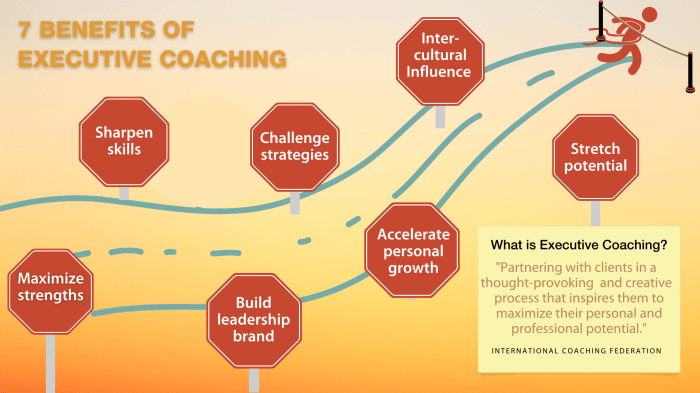
Executive leadership coaching is more than just professional development; it’s a transformative journey designed to unlock the full potential of top-tier leaders. This intensive process focuses on honing crucial skills, addressing specific leadership challenges, and fostering a growth mindset that drives both personal and organizational success. It’s about creating self-aware, adaptable leaders capable of navigating the complexities of the modern business world.
Through personalized strategies and tailored interventions, executive coaching helps leaders refine their decision-making processes, enhance communication skills, build stronger teams, and ultimately achieve significant improvements in business performance. This guide delves into the core components of executive leadership coaching, exploring its methodologies, benefits, and ethical considerations.
The Relationship Between Leadership Coaching and Business Development
Leadership coaching plays a pivotal role in enhancing business development strategies, fostering a more robust and profitable organization. By focusing on the development of key leadership skills, coaching directly impacts a company’s ability to adapt, innovate, and achieve its strategic objectives. This symbiotic relationship between leadership effectiveness and business success is explored further below.Leadership coaching contributes to improved business development strategies by cultivating a more effective leadership team.
This improved effectiveness translates into clearer strategic vision, better execution, and a more engaged workforce. Coaching helps leaders hone skills in areas such as strategic thinking, communication, decision-making, and team building, all of which are crucial for successful business development.
Effective Leadership’s Impact on Business Growth and Profitability
Effective leadership directly influences a company’s bottom line. Leaders who can inspire, motivate, and guide their teams effectively create a more productive and innovative work environment. This leads to increased efficiency, improved product development, enhanced customer satisfaction, and ultimately, higher profitability. For example, a study by the Center for Creative Leadership found a strong correlation between leadership development and improved financial performance in organizations.
Companies with robust leadership development programs consistently outperformed their counterparts in terms of revenue growth and shareholder return. Furthermore, effective leadership fosters a culture of continuous improvement, encouraging innovation and adaptation to changing market conditions, leading to sustained growth.
Comparison of Leadership Coaching and Business Development Roles in Achieving Organizational Goals
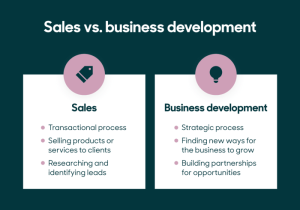
While leadership coaching and business development are distinct functions, they are deeply interconnected in the pursuit of organizational goals. Business development focuses on external factors, such as market analysis, sales strategies, and new product launches. Leadership coaching, on the other hand, focuses on internal factors, developing the capabilities of the leadership team to effectively execute business development strategies. Both are essential; effective business development strategies require strong leadership to implement them successfully, and strong leadership is enhanced through coaching, making it better equipped to achieve the organization’s strategic objectives.
They work synergistically – strong leadership enables effective implementation of business development initiatives, leading to stronger results and reinforcing the need for continued leadership development.
Examples of Leadership Coaching’s Positive Impact on Business Outcomes
Consider a tech startup facing rapid growth. Leadership coaching helped the CEO refine communication skills and delegate effectively, preventing burnout and allowing them to focus on strategic planning. This resulted in a more streamlined operation and a 30% increase in productivity within six months. In another case, a manufacturing company experiencing high employee turnover utilized leadership coaching to improve management styles.
This led to a significant reduction in employee turnover, resulting in cost savings associated with recruitment and training. Finally, a retail company undergoing a significant restructuring leveraged leadership coaching to foster collaboration and innovation among its leadership team. This resulted in a successful reorganization and a 15% increase in sales within the following year. These are just a few illustrations of how targeted leadership coaching can translate into tangible and significant business improvements.
Leadership Coaching and Business Ethics

Ethical considerations are paramount in executive leadership coaching. A strong ethical foundation is crucial for building trust, fostering positive organizational culture, and ensuring sustainable business success. Coaching that integrates ethical frameworks helps executives navigate complex situations and make responsible decisions that benefit all stakeholders.The integration of ethical considerations into executive leadership coaching is vital for several reasons. It helps cultivate leaders who prioritize integrity, transparency, and accountability, ultimately contributing to a more responsible and sustainable business environment.
This approach not only mitigates risks associated with unethical behavior but also enhances the organization’s reputation and attracts talent that values ethical leadership.
Ethical Decision-Making Promotion Through Coaching
Coaching methodologies can significantly enhance ethical decision-making within organizations. Coaches often employ frameworks such as ethical decision-making models (utilitarian, deontological, virtue ethics) to guide executives in analyzing ethical dilemmas. Through reflective questioning and scenario planning, coaches help executives anticipate potential ethical conflicts and develop strategies to address them proactively. The coaching process emphasizes critical thinking, empathy, and a commitment to ethical principles, leading to more informed and responsible choices.
This proactive approach fosters a culture of ethical awareness and responsibility throughout the organization.
The Coach’s Role in Addressing Ethical Dilemmas
The leadership coach plays a critical role in helping executives navigate ethical dilemmas. They act as a sounding board, providing a safe space for executives to explore complex issues without fear of judgment. Coaches help executives clarify their values, identify potential biases, and consider the impact of their decisions on various stakeholders. They facilitate a process of self-reflection, encouraging executives to examine their own ethical compass and align their actions with their stated values.
Importantly, the coach does not provide direct answers or solutions but rather guides the executive to arrive at their own well-reasoned and ethical conclusion.
Examples of Ethical Challenges and Coaching Interventions
Executives frequently encounter ethical challenges such as conflicts of interest, bribery and corruption, data privacy violations, and environmental sustainability issues. For instance, an executive might face pressure to compromise safety standards to meet production deadlines. A coach could help this executive explore the potential consequences of such a decision, including reputational damage, legal ramifications, and employee safety risks. Through guided discussions, the coach could assist the executive in developing alternative solutions that prioritize ethical considerations without sacrificing business objectives.
Similarly, an executive facing a conflict of interest could work with a coach to identify and mitigate potential biases, ensuring transparency and fairness in their decision-making. In situations involving environmental concerns, a coach could guide the executive in developing sustainable practices that align with the organization’s ethical values and contribute to a positive social impact.
Leadership Coaching, Business Coaching, and Other Related Concepts
Executive leadership coaching, while sharing similarities with business coaching and other related services, possesses a distinct focus and value proposition. Understanding these nuances is crucial for executives seeking to maximize their personal and professional growth. This section will clarify the differences and overlaps between these various coaching modalities.Executive leadership coaching concentrates on developing the strategic thinking, decision-making, and interpersonal skills necessary for leading teams and organizations effectively.
Business coaching, on the other hand, often takes a broader perspective, encompassing operational efficiency, sales growth, and overall business performance. While both types of coaching can involve similar techniques, their ultimate goals and target audiences differ significantly.
Comparison of Executive Leadership Coaching and Business Coaching
Executive leadership coaching primarily focuses on the individual leader’s development, aiming to enhance their leadership style, emotional intelligence, and strategic vision. The scope is often more personal and transformative, addressing the leader’s self-awareness, communication style, and ability to inspire and motivate others. Business coaching, conversely, is more focused on the business itself, helping owners or managers improve operational processes, increase profitability, and achieve specific business objectives.
It may involve analyzing market trends, developing sales strategies, or improving team productivity. While an executive might benefit from business coaching to understand the overall health of their organization, the core focus remains on improving business outcomes, not necessarily the executive’s personal leadership skills.
Areas of Overlap and Divergence
Both executive leadership coaching and business coaching utilize many similar tools and techniques, such as goal setting, action planning, and accountability mechanisms. However, the application and context differ. For example, goal setting in executive leadership coaching might focus on developing a more inclusive leadership style, while in business coaching it might focus on increasing market share. Similarly, both types might use feedback mechanisms, but in executive coaching, the feedback would center on leadership effectiveness, whereas in business coaching, the feedback would relate to business performance indicators.
The key divergence lies in the primary focus: the individual leader versus the business entity.
Unique Value Proposition of Executive Leadership Coaching
The unique value proposition of executive leadership coaching stems from its intense personalization and focus on the development of the individual leader. It goes beyond simply improving business outcomes; it aims to cultivate a more effective, resilient, and impactful leader. This translates to long-term benefits for the organization, as a stronger leader can navigate complex challenges, foster a positive work environment, and drive sustainable growth.
The return on investment isn’t solely measured in immediate business results but also in the enhanced leadership capacity of the executive, which can have a cascading positive effect on the entire organization.
Key Differences Between Executive Leadership Coaching, Business Coaching, and Other Relevant Services
The following table summarizes the key distinctions between executive leadership coaching, business coaching, and other relevant services like life coaching and career coaching.
| Coaching Type | Primary Focus | Target Audience | Key Outcomes |
|---|---|---|---|
| Executive Leadership Coaching | Developing leadership skills, strategic thinking, and emotional intelligence | Senior executives, C-suite leaders | Improved leadership effectiveness, enhanced team performance, strategic vision |
| Business Coaching | Improving business performance, operational efficiency, and profitability | Business owners, managers, entrepreneurs | Increased revenue, improved efficiency, enhanced market position |
| Life Coaching | Personal growth, well-being, and goal achievement in various life areas | Individuals seeking personal development | Improved self-awareness, enhanced life satisfaction, achievement of personal goals |
| Career Coaching | Career planning, job search strategies, and professional development | Individuals seeking career advancement or change | Improved career prospects, enhanced job skills, successful career transitions |
The Impact of Business Loans, Models, Strategies, and Travel on Executive Leadership
Access to capital, business models, strategic planning, and the demands of international business travel all significantly shape the experiences and decision-making processes of executive leaders. Understanding these influences is crucial for developing effective leadership strategies and fostering organizational success.Business loans, models, strategies, and travel each present unique challenges and opportunities for executive leadership, requiring adaptable and strategic decision-making.
Business Loans and Leadership Decisions
Securing business loans often necessitates a detailed strategic plan and strong financial projections. This process forces executives to rigorously analyze their business, identify potential risks and opportunities, and articulate a clear vision for future growth. The need to demonstrate financial viability can encourage more data-driven decision-making and a focus on long-term sustainability. Conversely, the pressure to meet loan repayment schedules can lead to short-term prioritization, potentially impacting long-term strategic goals if not managed carefully.
For example, a company securing a loan for expansion might prioritize rapid market penetration, potentially neglecting areas such as employee training or research and development in the short term.
Business Models and Leadership Styles
Different business models demand different leadership approaches. A fast-growing startup, for instance, might necessitate a highly adaptable and entrepreneurial leadership style, focused on rapid innovation and risk-taking. In contrast, a well-established corporation might require a more structured and process-oriented leadership style, emphasizing efficiency, stability, and consistent execution. A company operating under a franchise model needs leaders skilled in balancing autonomy with brand consistency, requiring strong communication and relationship-building skills.
Business Strategy and Leadership Development
Business strategy directly influences the priorities for leadership development. A company focusing on innovation might prioritize leadership training in creativity and strategic thinking. A company emphasizing operational excellence might prioritize training in process improvement and efficiency. For example, a company undergoing a digital transformation might invest heavily in leadership development programs focused on technology adoption and change management.
The strategic goals of the organization should directly inform the skills and competencies that are developed within the leadership team.
Business Travel and Executive Leadership
Business travel, while offering opportunities for networking, client relationship building, and firsthand market research, also presents significant challenges. The time away from the office can disrupt workflows and communication, requiring proactive planning and delegation. Frequent travel can lead to exhaustion and burnout, impacting decision-making and overall effectiveness. However, successful navigation of these challenges can enhance an executive’s global perspective, strategic thinking, and cross-cultural communication skills.
For instance, an executive traveling extensively to build international partnerships gains valuable insights into diverse market dynamics and cultural nuances, fostering more informed strategic decisions.
Ultimately, executive leadership coaching represents a strategic investment in both individual leaders and the organizations they serve. By fostering self-awareness, enhancing key skills, and promoting ethical leadership practices, coaching empowers executives to navigate challenges, drive innovation, and achieve sustainable success. The return on investment extends beyond quantifiable metrics, encompassing a culture of growth, improved employee engagement, and a more resilient and adaptable organization.
FAQs
What is the typical duration of an executive coaching program?
The length varies depending on the individual’s needs and goals, but programs often range from three to twelve months, with sessions typically scheduled weekly or bi-weekly.
How much does executive coaching cost?
Costs are highly variable and depend on factors such as the coach’s experience, the program’s duration, and the frequency of sessions. Expect a significant investment.
How do I find a qualified executive coach?
Look for coaches with proven experience, relevant certifications (like ICF credentials), and strong client testimonials. Networking and referrals can be invaluable.
What if I don’t see immediate results from coaching?
Leadership development is a process, not a quick fix. Consistent effort and commitment are key. Open communication with your coach is crucial to address any concerns and adjust the approach as needed.