In today’s dynamic business landscape, ethical considerations are no longer a mere afterthought but a cornerstone of sustainable success. The pursuit of profit shouldn’t overshadow the fundamental principles of integrity, fairness, and responsibility. This exploration delves into the multifaceted nature of business ethics, examining its impact on various stakeholders, the cultivation of ethical cultures, and the crucial role of leadership in shaping ethical conduct.
From defining core ethical principles and navigating ethical dilemmas to measuring ethical performance and fostering a culture of integrity, this guide provides a practical framework for businesses of all sizes to navigate the complex world of ethical decision-making. We will explore real-world examples, case studies, and best practices to illustrate the significant advantages of prioritizing ethical conduct.
Defining Business Ethics
Business ethics represent the moral principles and values that guide the conduct of individuals and organizations in the business world. They dictate how businesses should operate, interact with stakeholders, and make decisions in a responsible and fair manner. These principles are not merely suggestions but form the bedrock of a company’s reputation and long-term sustainability.Business ethics encompass a broad range of issues, from environmental responsibility and fair labor practices to honest advertising and data privacy.
The core principles often include honesty, integrity, fairness, respect, responsibility, and transparency. These principles are applied differently depending on the specific business context, considering factors like industry regulations, cultural norms, and stakeholder expectations. For example, a pharmaceutical company must prioritize patient safety above profit, while a technology firm must address concerns about data security and user privacy.
Ethical Dilemmas in Business
Businesses frequently encounter situations that present ethical challenges. These dilemmas often involve conflicts between competing values or interests. A common example is the pressure to prioritize short-term profits over long-term sustainability. Consider a company facing the choice between investing in environmentally friendly practices that would reduce profits in the short term or continuing with less sustainable practices for immediate financial gains.
Another example involves a conflict between loyalty to an employer and a commitment to ethical conduct. An employee might discover illegal or unethical activity within their organization. They face a dilemma: report the activity and risk job security or remain silent and compromise their ethical principles. These situations highlight the need for robust ethical frameworks and a strong ethical culture within organizations.
Legal Compliance versus Ethical Conduct
While closely related, legal compliance and ethical conduct are distinct concepts. Legal compliance refers to adhering to all applicable laws and regulations. Ethical conduct, however, goes beyond mere legal compliance, encompassing a broader set of moral principles and values. A business might be fully compliant with the law but still engage in ethically questionable practices. For example, a company might legally avoid paying taxes through loopholes, even though this is ethically dubious as it reduces the resources available for public services.
Conversely, a business might choose to act ethically even when not legally required to do so. This might involve investing in employee well-being programs that exceed legal minimums or engaging in philanthropic activities. Ethical conduct demonstrates a commitment to doing what is right, even when it is not legally mandated.
Ethical Frameworks in Business Decision-Making
The following table compares several ethical frameworks commonly used in business decision-making:
| Ethical Framework | Description | Focus | Example in Business |
|---|---|---|---|
| Utilitarianism | Focuses on maximizing overall happiness and well-being for the greatest number of people. | Consequences | A company might choose to lay off a smaller number of employees to save the jobs of a larger number, even if it means hardship for those laid off. |
| Deontology | Emphasizes adherence to moral duties and rules, regardless of the consequences. | Duties and Rights | A company might refuse to engage in price-fixing, even if it means losing market share, because it is inherently unethical and violates its moral duty to fair competition. |
| Virtue Ethics | Focuses on cultivating virtuous character traits, such as honesty, integrity, and compassion. | Character | A company might prioritize ethical sourcing of materials even if it is more expensive, because it reflects the company’s commitment to ethical business practices and responsible sourcing. |
| Rights-Based Ethics | Emphasizes respecting the fundamental rights of individuals, such as the right to life, liberty, and property. | Individual Rights | A company might ensure fair wages and safe working conditions for its employees, regardless of the cost, because it recognizes their fundamental right to decent treatment. |
The Impact of Unethical Behavior
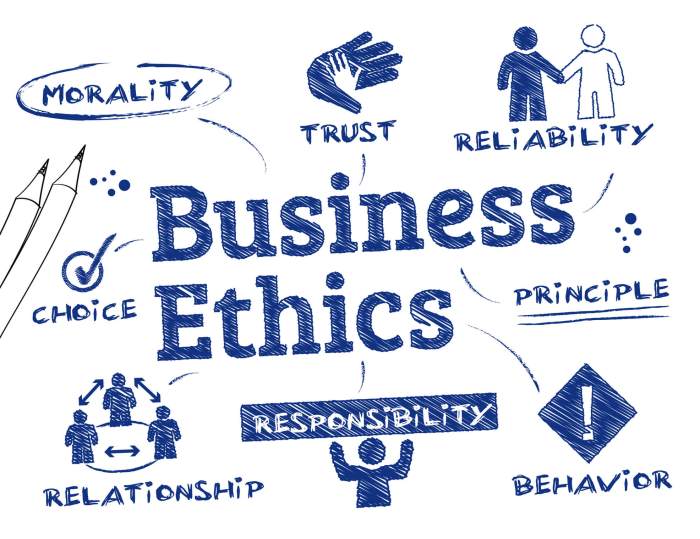
Unethical business practices, while potentially offering short-term gains, ultimately inflict significant damage on various stakeholders and the long-term sustainability of a company. The consequences ripple outwards, affecting not only the company’s reputation and financial health but also the trust placed in the broader business environment. Ignoring ethical considerations can lead to a cascade of negative outcomes, making a strong ethical framework crucial for sustained success.The repercussions of unethical behavior manifest in both the short-term and long-term, impacting various stakeholders including employees, customers, investors, and the wider community.
Short-term consequences might involve decreased employee morale and productivity, damaged customer relationships leading to loss of sales, and potential legal challenges resulting in fines. Long-term impacts, however, are far more devastating and can include irreparable reputational damage, loss of investor confidence, decreased market share, and ultimately, business failure.
Short-Term and Long-Term Consequences of Unethical Business Practices
Short-term consequences often manifest as immediate reactions to unethical actions. For instance, a company engaging in misleading advertising might experience a temporary sales boost but face swift backlash from consumers leading to boycotts and damaged brand image. Internally, unethical practices like unfair labor practices can result in employee unrest, reduced productivity, and increased employee turnover. Long-term, however, the consequences are far more profound and potentially irreversible.
The erosion of trust among customers, investors, and the wider public can take years to rebuild, if it can be rebuilt at all. Continued unethical behavior can lead to significant financial losses, legal battles, and ultimately, the demise of the business.
Real-World Case Studies Illustrating Negative Impacts
The Enron scandal serves as a stark example of the devastating consequences of unethical behavior. Enron’s fraudulent accounting practices, designed to inflate its profits and hide massive debts, ultimately led to the company’s bankruptcy, wiping out billions of dollars in shareholder value and causing widespread job losses. The scandal also significantly eroded public trust in corporate America and led to increased regulatory scrutiny.
Similarly, Volkswagen’s “Dieselgate” scandal, involving the manipulation of emissions tests, resulted in billions of dollars in fines, significant reputational damage, and a massive recall of affected vehicles. These examples highlight the severe financial and reputational risks associated with unethical business practices.
Legal and Financial Ramifications of Unethical Actions
Unethical business actions frequently trigger legal ramifications, ranging from civil lawsuits to criminal charges. Companies engaging in fraudulent activities, price-fixing, or violating environmental regulations can face hefty fines, penalties, and even imprisonment for executives. The financial consequences can be catastrophic, including substantial legal fees, compensation payments to victims, and damage to brand value, which can translate into lost revenue and decreased profitability.
Beyond direct financial penalties, the indirect costs of reputational damage and lost business opportunities can be equally significant, impacting the company’s long-term viability.
Chain Reaction of Unethical Decisions Within an Organization
The following flowchart illustrates how a single unethical decision can trigger a cascade of negative consequences within an organization.[Diagram description: A flowchart begins with a single box labeled “Unethical Decision.” This box leads to three branching boxes: “Decreased Employee Morale,” “Damaged Customer Relationships,” and “Legal Scrutiny.” Each of these boxes then leads to further consequences, such as “Increased Turnover,” “Loss of Sales,” and “Fines/Penalties,” respectively.
Finally, all three consequence branches converge into a final box labeled “Reputational Damage and Financial Loss.”]
Building an Ethical Business Culture
Cultivating a strong ethical culture isn’t merely a matter of compliance; it’s the foundation upon which successful and sustainable businesses are built. An ethical workplace fosters trust, improves employee morale, enhances brand reputation, and ultimately drives profitability. This section Artikels key strategies for establishing and maintaining such a culture.
A robust ethical culture is not created overnight; it requires a sustained and multifaceted approach. It necessitates leadership commitment, clear communication, comprehensive training, and consistent reinforcement of ethical principles throughout the organization. The aim is to embed ethical considerations into every aspect of business operations, from strategic planning to daily interactions.
Strategies for Fostering a Strong Ethical Culture
Creating a truly ethical business environment requires a holistic approach. It involves a commitment from leadership, comprehensive training, clear guidelines, and ongoing monitoring and evaluation. Several key strategies are crucial for building and sustaining this culture. These include establishing a clear code of conduct, providing ethics training, promoting open communication, implementing effective reporting mechanisms, and consistently rewarding ethical behavior.
Effective Ethics Training Programs and Communication Strategies
Effective ethics training goes beyond simply disseminating a code of conduct. Interactive workshops, case studies, and role-playing scenarios can help employees grapple with complex ethical dilemmas in a safe and supportive environment. Communication should be multifaceted, utilizing various channels like internal newsletters, company intranets, and regular town hall meetings to ensure consistent messaging and reinforce ethical principles. For example, a company might use interactive online modules that present realistic scenarios and quiz employees on ethical decision-making.
Another approach could involve inviting external ethics experts to lead workshops, fostering open dialogue and addressing employee concerns.
Establishing Clear Ethical Guidelines and Codes of Conduct
A well-defined code of conduct serves as a cornerstone of an ethical business culture. It should be concise, accessible, and easily understood by all employees, regardless of their role or level within the organization. The code should clearly articulate the company’s values, principles, and expectations regarding ethical behavior. It should also Artikel specific procedures for reporting ethical violations and addressing concerns.
For instance, a code of conduct might specifically address issues such as conflict of interest, bribery, data privacy, and environmental responsibility. Furthermore, the code should be regularly reviewed and updated to reflect changes in legislation, best practices, and the evolving needs of the business.
Practical Steps to Promote Ethical Decision-Making at All Levels
Promoting ethical decision-making requires a proactive and multi-pronged approach. Companies should establish clear reporting mechanisms for ethical concerns, ensuring that employees feel safe and empowered to raise issues without fear of retaliation. Leadership should actively model ethical behavior and create a culture of accountability. Regular ethics audits and assessments can help identify areas for improvement and ensure that the company’s ethical standards are being upheld.
Furthermore, integrating ethics into performance evaluations and reward systems can reinforce the importance of ethical conduct. For example, a company might include ethical considerations in employee performance reviews, rewarding those who demonstrate ethical leadership and decision-making. Another practical step would be the establishment of an ethics committee or ombudsman to investigate and address ethical concerns independently.
Ethics in Specific Business Areas
Ethical considerations permeate every aspect of business operations, demanding careful navigation to ensure responsible and sustainable growth. Understanding and applying ethical principles in various business areas is crucial for maintaining a positive reputation, fostering trust with stakeholders, and achieving long-term success. This section will explore the ethical dimensions of several key business functions.
Responsible Growth Strategies in Business Development
Business development, while focused on expansion and profitability, must be grounded in ethical practices. Responsible growth prioritizes sustainable development, minimizing negative environmental and social impacts. This involves carefully considering the long-term consequences of expansion plans, ensuring fair labor practices within the supply chain, and actively contributing to the well-being of the communities where the business operates. For instance, a company expanding its operations into a developing country should prioritize fair wages, safe working conditions, and environmental protection, rather than solely focusing on maximizing profits at the expense of local communities and resources.
A commitment to transparent and accountable business practices is also essential, ensuring that growth is not achieved through unethical means such as bribery or corruption.
Ethical Challenges in Business Coaching and Mentoring
Business coaching and mentoring involve a power dynamic that necessitates a strong ethical framework. Maintaining professional boundaries, avoiding conflicts of interest, and ensuring confidentiality are paramount. Ethical coaches and mentors prioritize the client’s best interests, offering unbiased guidance and support. They avoid exploiting the relationship for personal gain, such as promoting their own products or services without disclosing potential conflicts of interest.
Furthermore, they should maintain a high level of professional competence, ensuring they possess the necessary skills and knowledge to provide effective guidance. A breach of confidentiality or a conflict of interest can severely damage the mentor-mentee relationship and harm the mentee’s business.
Ethical Considerations in Securing Business Loans versus Profit Maximization
Securing business loans often requires presenting a realistic and accurate financial picture. Ethical considerations involve providing complete and truthful information to lenders, avoiding misleading statements or omissions. Conversely, some business models prioritize profit maximization above all else, potentially leading to unethical practices such as aggressive marketing tactics, exploitation of workers, or cutting corners on quality. The ethical approach involves striking a balance between profitability and responsible business practices, ensuring that profit maximization does not come at the expense of ethical conduct.
For example, a company might choose a less profitable but more sustainable business model, even if a more profitable option exists but involves unethical practices.
Ethical Implications of Marketing, Sales, and Operations Strategies
Marketing, sales, and operations strategies should align with ethical principles. Marketing should avoid deceptive advertising, manipulative sales tactics, or targeting vulnerable populations. Sales teams must operate with integrity, avoiding pressure tactics or misrepresentation of products or services. Operations should prioritize fair labor practices, environmental sustainability, and product safety. For instance, an ethically sound marketing campaign will accurately represent the product or service, avoiding false claims or misleading imagery.
Similarly, ethical sales practices involve building trust with customers through honest communication and transparency. In operations, adhering to environmental regulations and ensuring safe working conditions demonstrates a commitment to ethical conduct.
Case Study: Ethical Considerations of International Business Travel
Imagine a company sending a team to negotiate a significant deal in a country known for corruption. The team faces several ethical dilemmas. They might be offered bribes to secure the deal, pressured to engage in unethical practices, or witness questionable business dealings by local counterparts. The ethical course of action involves establishing clear guidelines before the trip, including a strict policy against bribery and corruption.
The team should be equipped to navigate challenging situations ethically, prioritizing transparency and integrity even if it means jeopardizing the deal. Post-trip, the company should review the team’s experiences, documenting any ethical challenges faced and refining internal policies to prevent similar situations in the future. This includes ensuring appropriate training for employees traveling internationally, equipping them with the knowledge and resources to navigate complex ethical situations.
Measuring and Improving Ethical Performance
Measuring and improving ethical performance is a crucial aspect of building a sustainable and successful business. It involves establishing clear metrics, conducting regular assessments, and implementing corrective actions to address any ethical weaknesses. A proactive approach to ethical performance ensures long-term viability and enhances stakeholder trust.
Key Performance Indicators (KPIs) for Ethical Performance
Effective measurement requires identifying key performance indicators (KPIs) that reflect a company’s ethical conduct. These KPIs should be specific, measurable, achievable, relevant, and time-bound (SMART). A comprehensive approach considers both the frequency and severity of ethical breaches, alongside the effectiveness of preventative measures.
- Number of ethical violations reported: This KPI tracks the frequency of reported ethical breaches, providing insight into the prevalence of unethical behavior within the organization. A high number suggests a potential need for improved ethical training or stronger enforcement mechanisms.
- Employee satisfaction with ethical culture: Measuring employee perception of the ethical climate through surveys or feedback mechanisms provides valuable insights into the effectiveness of ethical initiatives. High satisfaction indicates a strong ethical culture.
- Percentage of employees completing ethics training: This KPI monitors the effectiveness of ethics training programs by tracking participation rates. High completion rates suggest a commitment to ethical development within the workforce.
- Cost of ethical violations: This KPI quantifies the financial impact of ethical breaches, including legal fees, fines, and reputational damage. A high cost underscores the importance of proactive ethical measures.
- Customer trust and loyalty scores: Measuring customer perception of the company’s ethical practices can be a crucial indicator of long-term success. High scores suggest strong ethical alignment with customer values.
Ethical Audits and Assessments
Ethical audits and assessments provide a systematic evaluation of a company’s ethical performance. These evaluations can involve internal reviews, third-party assessments, or a combination of both. The goal is to identify areas of strength and weakness, and to provide recommendations for improvement.
Methods for conducting these assessments include:
- Review of policies and procedures: Examining existing policies and procedures to ensure alignment with ethical standards and legal requirements.
- Interviews with employees at all levels: Gathering firsthand accounts of ethical experiences and challenges within the organization.
- Analysis of whistleblowing reports: Investigating reported ethical violations to understand their root causes and implement corrective actions.
- Review of external communications: Assessing public perception of the company’s ethical practices through media monitoring and social media analysis.
- Benchmarking against industry best practices: Comparing ethical performance to that of similar companies to identify areas for improvement.
Implementing Corrective Actions
Once ethical weaknesses are identified, a structured approach to implementing corrective actions is essential. This involves developing and implementing targeted strategies to address specific issues.
Strategies for addressing identified weaknesses may include:
- Revised codes of conduct and ethics policies: Updating policies to reflect current best practices and address identified shortcomings.
- Enhanced ethics training programs: Developing and delivering comprehensive training programs to raise awareness and improve ethical decision-making skills.
- Strengthened internal controls and compliance mechanisms: Implementing measures to prevent and detect unethical behavior, such as improved reporting systems and whistleblower protection.
- Disciplinary actions for ethical violations: Implementing consistent and fair disciplinary procedures for employees who violate ethical standards.
- Improved communication and transparency: Fostering open communication and transparency within the organization to promote ethical conduct.
Ongoing Monitoring and Improvement
Sustaining ethical performance requires ongoing monitoring and continuous improvement. This involves regularly reviewing KPIs, conducting periodic ethical audits, and adapting strategies based on emerging challenges and best practices.
A plan for ongoing monitoring might include:
- Regular reporting on ethical KPIs: Tracking key metrics on a regular basis to monitor progress and identify trends.
- Periodic ethical audits and assessments: Conducting regular assessments to identify emerging ethical risks and challenges.
- Review and update of ethics policies and procedures: Regularly reviewing and updating policies to ensure they remain relevant and effective.
- Employee feedback mechanisms: Establishing mechanisms for employees to provide feedback on ethical issues and concerns.
- Collaboration with external stakeholders: Engaging with stakeholders such as customers, suppliers, and community groups to build trust and improve ethical performance.
The Relationship Between Ethics and Business Success
Ethical business practices are not merely a matter of social responsibility; they are a cornerstone of long-term profitability and sustainable growth. A strong ethical foundation fosters trust, enhances reputation, and ultimately drives business success in a competitive marketplace. Ignoring ethical considerations, conversely, can lead to significant financial losses, reputational damage, and even legal repercussions.Ethical behavior and financial performance are positively correlated.
Companies that prioritize ethical conduct often experience higher levels of investor confidence, stronger customer loyalty, and improved employee morale, all of which contribute to increased profitability. This positive correlation is not merely anecdotal; substantial research supports the claim that ethical businesses tend to outperform their less ethical counterparts over the long term.
Ethical Business Practices and Long-Term Profitability
Numerous studies have demonstrated a clear link between ethical business practices and sustained financial success. Companies that prioritize ethical sourcing, fair labor practices, and environmental sustainability often attract and retain customers who value these principles. This translates into increased market share, higher prices (due to brand premium), and reduced operational costs associated with scandals or lawsuits. For example, Patagonia, a company renowned for its commitment to environmental sustainability and fair labor practices, has consistently demonstrated strong financial performance while maintaining its ethical standards.
Their commitment to responsible sourcing and environmental protection resonates deeply with their target market, leading to strong brand loyalty and premium pricing. Conversely, companies involved in unethical practices, such as bribery or environmental damage, often face significant financial penalties, boycotts, and reputational damage, negatively impacting their bottom line.
Examples of Successful Ethical Businesses
Patagonia’s success is just one example. Companies like Unilever, with its Sustainable Living Plan focusing on social and environmental impact, and TOMS Shoes, known for its “One for One” giving model, also demonstrate the positive correlation between ethics and business success. These companies have not only achieved financial success but also built strong brand reputations based on their commitment to ethical principles.
Their ethical practices are integral to their brand identity, attracting customers who share their values and are willing to pay a premium for ethically sourced and produced goods. This demonstrates that ethical practices can be a significant competitive advantage.
Ethical Behavior and Increased Investor Confidence
Investors increasingly recognize the importance of environmental, social, and governance (ESG) factors in their investment decisions. Companies with strong ethical track records tend to attract more investors and command higher valuations. This is because investors understand that ethical businesses are less likely to face reputational crises, legal challenges, or operational disruptions resulting from unethical conduct. Studies have shown a positive correlation between ESG ratings and stock performance, indicating that investors are willing to pay a premium for companies with strong ethical profiles.
This heightened investor confidence translates into easier access to capital and lower borrowing costs, further contributing to financial success.
Ethical Practices and Enhanced Brand Reputation and Customer Loyalty
Strong ethical practices significantly enhance a company’s brand reputation and cultivate customer loyalty. Consumers are increasingly discerning and actively seek out businesses that align with their values. Companies known for their ethical conduct enjoy positive media coverage, strong word-of-mouth referrals, and increased consumer trust. This positive brand image translates into greater customer loyalty, repeat business, and a willingness to pay a premium for goods and services.
Conversely, companies involved in unethical practices often face consumer boycotts, negative media attention, and significant damage to their brand reputation, leading to decreased sales and lost market share. Building a strong ethical reputation is a long-term investment that pays dividends in increased customer loyalty and brand strength.
Ultimately, the importance of ethics in business transcends mere compliance; it represents a commitment to building trust, fostering positive relationships, and achieving long-term sustainability. By prioritizing ethical practices, businesses not only mitigate risks and enhance their reputation but also cultivate a more engaged and productive workforce, attract and retain top talent, and build stronger relationships with customers and investors. Embracing ethical conduct isn’t simply the right thing to do; it’s a strategic imperative for lasting success in the modern marketplace.
User Queries
What are some common ethical dilemmas faced by small businesses?
Small businesses often face dilemmas regarding fair wages, transparent pricing, and maintaining customer privacy, especially with limited resources and oversight.
How can a company measure its ethical performance effectively?
Ethical performance can be measured through employee surveys, customer feedback, internal audits, and tracking key performance indicators (KPIs) related to ethical conduct.
What legal repercussions can a business face for unethical behavior?
Unethical behavior can lead to fines, lawsuits, reputational damage, and even criminal charges depending on the severity and nature of the offense.
How can whistleblowing be encouraged in a company?
Companies can encourage whistleblowing by establishing clear and confidential reporting mechanisms, protecting whistleblowers from retaliation, and promoting a culture of open communication and accountability.