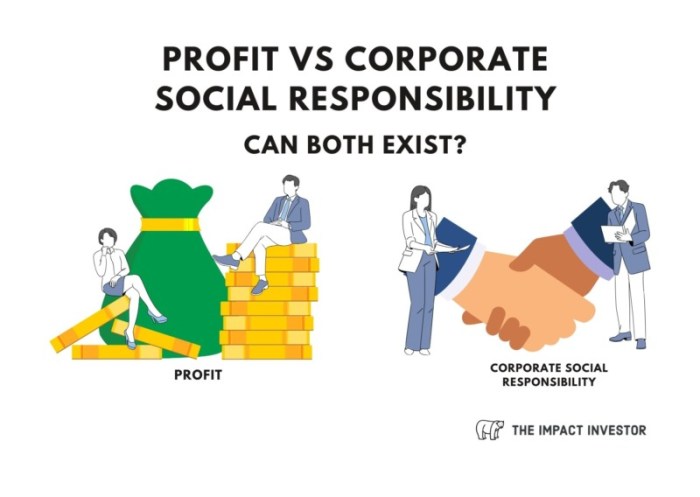
The age-old debate of prioritizing corporate social responsibility (CSR) over profit maximization continues to challenge businesses globally. This exploration delves into the complex interplay between ethical conduct and financial success, examining how companies navigate the often-conflicting demands of stakeholders and the bottom line. We’ll explore the potential synergies between responsible practices and profitability, while also acknowledging the inherent risks of neglecting ethical considerations.
This examination will cover various perspectives, including those of employees, customers, investors, and communities, highlighting the diverse expectations surrounding a company’s social and environmental impact. We’ll analyze successful strategies for integrating CSR into core business operations, exploring both established frameworks and innovative approaches to sustainable growth. Ultimately, the goal is to illuminate the path towards a more balanced and sustainable future for businesses and society alike.
Defining Corporate Responsibility and Profit
The ongoing debate surrounding corporate responsibility versus profit maximization highlights a fundamental tension within the business world. Understanding the core tenets of each concept is crucial to navigating this complex relationship and evaluating a company’s overall approach to its stakeholders. This section will define both corporate social responsibility (CSR) and profit maximization, comparing their underlying philosophies and illustrating them with real-world examples.
Corporate Social Responsibility (CSR)
Corporate social responsibility encompasses a company’s commitment to operating ethically and sustainably, considering its impact on society, the environment, and its employees. It goes beyond simply adhering to legal requirements; it’s about proactively integrating social and environmental concerns into business operations and decision-making. Core tenets include ethical labor practices, environmental stewardship, community engagement, and transparent governance. Companies demonstrating strong CSR often prioritize fair wages, safe working conditions, reducing their carbon footprint, and supporting local communities through philanthropy or volunteering.
Profit Maximization
Profit maximization, in a business context, refers to the primary goal of increasing a company’s profits to the greatest extent possible. This often involves strategies focused on efficiency, cost reduction, revenue growth, and maximizing shareholder value. While profit is essential for business survival and growth, a singular focus on profit maximization can sometimes lead to neglecting other important considerations, such as employee well-being or environmental protection.
The pursuit of profit often involves careful analysis of market trends, competitive landscapes, and operational efficiency to identify opportunities for increased revenue and decreased costs.
Contrasting Philosophies: Responsibility vs. Profit
The philosophies behind prioritizing corporate responsibility versus profit are fundamentally different. A CSR-focused approach views profit as a means to an end – a necessary resource to fund responsible operations and contribute positively to society. Profit maximization, on the other hand, often views responsibility as a secondary concern, potentially a cost to be minimized rather than an investment.
This difference in perspective can significantly impact a company’s strategies, resource allocation, and overall reputation. For example, a company prioritizing CSR might invest in renewable energy sources, even if it’s initially more expensive, while a company focused solely on profit might prioritize cheaper, less sustainable options.
Examples of Prioritized Approaches
Patagonia, a clothing company, exemplifies a strong commitment to CSR. They prioritize sustainable materials, fair labor practices, and environmental activism, often foregoing immediate profit maximization for long-term environmental and social benefits. Conversely, a company like Walmart, while undertaking some CSR initiatives, has historically faced criticism for prioritizing low prices and aggressive cost-cutting measures, sometimes at the expense of employee wages and environmental considerations.
These contrasting examples illustrate the spectrum of approaches companies take in balancing responsibility and profit.
The Interplay Between Responsibility and Profit
The relationship between corporate social responsibility (CSR) and profitability isn’t a zero-sum game; rather, it’s increasingly recognized as a dynamic interplay where responsible practices can significantly enhance, and irresponsible ones can severely damage, a company’s bottom line. This section explores the synergistic potential of CSR and profitability, examining how responsible business practices bolster brand reputation and customer loyalty, while conversely highlighting the risks of neglecting these crucial aspects.The potential for synergistic relationships between CSR and profitability is substantial.
Companies that prioritize ethical sourcing, environmental sustainability, and fair labor practices often find themselves attracting and retaining both top talent and loyal customers. This positive perception translates into increased brand value, enhanced market share, and ultimately, improved financial performance. Moreover, proactive CSR initiatives can mitigate risks associated with negative publicity, regulatory penalties, and reputational damage. By addressing societal and environmental concerns proactively, companies can build trust with stakeholders, fostering a more stable and predictable business environment.
Responsible Business Practices and Brand Enhancement
Responsible business practices directly contribute to a stronger brand reputation and increased customer loyalty. Consumers, particularly millennials and Gen Z, are increasingly discerning and actively seek out brands that align with their values. Companies demonstrating a genuine commitment to ethical and sustainable practices are rewarded with enhanced brand perception, leading to increased consumer trust and preference. This positive brand image can translate into higher pricing power, improved sales, and stronger market positioning.
For example, Patagonia’s commitment to environmental sustainability and fair labor practices has cultivated a fiercely loyal customer base willing to pay a premium for their products. Their consistent messaging and demonstrable actions have built a brand synonymous with quality and ethical responsibility, a significant driver of their financial success.
Risks Associated with Neglecting Corporate Responsibility
Neglecting corporate responsibility carries significant financial risks. Ignoring environmental concerns can lead to hefty fines and legal battles, as evidenced by numerous cases involving pollution and environmental damage. Similarly, unethical labor practices can result in negative media attention, boycotts, and damage to brand reputation, ultimately impacting sales and profitability. Furthermore, a lack of transparency and accountability can erode stakeholder trust, making it more challenging to attract investors and secure favorable financing terms.
The long-term consequences of irresponsible behavior can be far-reaching and financially devastating, impacting not only the company’s bottom line but also its long-term viability.
Case Studies: Long-Term Financial Impacts of Corporate Behavior
Several case studies illustrate the long-term financial impacts of both responsible and irresponsible corporate behavior. Unilever, a company known for its commitment to sustainable practices, has demonstrated a strong correlation between its CSR initiatives and its financial performance. Their focus on sustainable sourcing, reducing their environmental footprint, and improving the lives of their suppliers has contributed to consistent growth and increased shareholder value.
Conversely, companies like Volkswagen, embroiled in the emissions scandal, suffered significant financial losses due to reputational damage, legal penalties, and decreased sales. The long-term costs of their irresponsible behavior far outweighed any short-term gains. These examples highlight the critical importance of integrating CSR into core business strategy for long-term financial success and sustainability.
Stakeholder Perspectives
Corporate decisions significantly impact various stakeholders, each with unique interests and expectations regarding the balance between corporate responsibility and profit maximization. Understanding these diverse perspectives is crucial for navigating the complexities of ethical business practices and achieving sustainable success.Stakeholder interests are often intertwined, yet sometimes conflicting, necessitating careful consideration and proactive conflict management strategies. This section will examine key stakeholder groups, their differing priorities, potential conflicts, and methods for resolving these conflicts.
Key Stakeholder Groups and Their Interests
Several key stakeholder groups are significantly affected by a company’s actions. These include employees, customers, investors, and the communities in which the company operates. Employees are primarily interested in fair wages, safe working conditions, job security, and opportunities for professional development. Customers focus on product quality, value for money, ethical sourcing, and excellent customer service. Investors prioritize profitability, return on investment, and responsible risk management.
Communities, meanwhile, are concerned with environmental protection, job creation, and the company’s overall contribution to the local economy and social well-being. The expectations of these groups regarding corporate responsibility vary considerably, often leading to potential conflicts.
Comparison of Stakeholder Expectations
Investors often prioritize short-term profits, potentially leading to pressure for cost-cutting measures that could negatively impact employee wages or environmental protection. Conversely, employees and communities might advocate for higher ethical standards and sustainable practices, even if these measures reduce short-term profits. Customers, increasingly conscious of ethical and environmental issues, may favor companies with strong corporate social responsibility (CSR) initiatives, even if it means slightly higher prices.
Balancing these diverse expectations requires careful strategic planning and transparent communication.
Potential Conflicts of Interest and Management Strategies
A common conflict arises between maximizing shareholder returns and upholding high ethical standards. For instance, a company might face pressure to relocate production to a country with lower labor costs and less stringent environmental regulations, increasing profits but potentially harming employees and the environment in both locations. Another example involves the dilemma between investing in sustainable practices (which might initially reduce profits) and meeting investor expectations for immediate returns.
Managing these conflicts requires a well-defined CSR strategy, robust stakeholder engagement processes, and transparent communication to ensure all stakeholders understand the company’s rationale and approach. This often involves finding creative solutions that balance short-term financial goals with long-term sustainability and ethical considerations. Independent audits and ethical guidelines can further enhance transparency and accountability.
Hypothetical Scenario and Proposed Solution
Imagine a hypothetical scenario where a clothing company faces pressure to reduce production costs. One option is to outsource manufacturing to a factory known for employing child labor and using unsustainable production methods. This would significantly increase profits in the short term, satisfying investor demands. However, this would severely damage the company’s reputation, alienate customers, and violate ethical standards, negatively impacting long-term sustainability.
The proposed solution is to invest in ethical and sustainable sourcing, potentially through partnerships with fair-trade suppliers and implementation of environmentally friendly production processes. While this might initially reduce profit margins, it would protect the company’s reputation, attract environmentally conscious consumers, and foster stronger relationships with stakeholders, leading to long-term growth and success. Transparency regarding these choices and their impact on profit and ethical considerations is crucial in managing stakeholder expectations.
Measuring and Reporting Corporate Responsibility
Accurately measuring and transparently reporting a company’s social and environmental impact is crucial for demonstrating genuine commitment to corporate social responsibility (CSR) and building trust with stakeholders. This involves selecting appropriate metrics, collecting reliable data, and utilizing established reporting frameworks to communicate performance effectively. Effective measurement and reporting also enables continuous improvement and accountability.Measuring the social and environmental impact of a business requires a multifaceted approach.
It’s not simply about profit; it encompasses a broad range of activities and their consequences.
Methods for Measuring Social and Environmental Impact
Various methods exist for quantifying a business’s social and environmental performance. These methods often involve both quantitative and qualitative data collection and analysis. Quantitative data provides numerical measures, while qualitative data offers contextual understanding. Examples include surveys, environmental audits, employee feedback mechanisms, and analysis of operational data related to energy consumption, waste generation, and emissions. The selection of appropriate methods depends on the specific CSR goals and the nature of the business.
For instance, a manufacturing company might focus on measuring emissions and waste, while a technology company might prioritize data privacy and employee well-being metrics.
Key Performance Indicators (KPIs) for CSR Performance
A selection of key performance indicators (KPIs) allows for the systematic tracking of progress toward CSR goals. These KPIs should align with the company’s specific CSR strategy and be measurable, achievable, relevant, and time-bound (SMART).
| KPI | Target | Actual | Variance |
|---|---|---|---|
| Greenhouse Gas Emissions (tons CO2e) | Reduce by 20% by 2025 | Reduced by 15% in 2024 | -5% |
| Employee Satisfaction (score out of 10) | 8.0 | 7.5 | -0.5 |
| Percentage of Recycled Waste | 75% | 70% | -5% |
| Number of Diversity and Inclusion Training Programs Conducted | 5 | 6 | +1 |
Transparent Reporting of CSR Activities
Transparent reporting is vital for building stakeholder trust and demonstrating accountability. Companies should clearly communicate their CSR strategy, goals, performance, and challenges. This involves using accessible language, providing detailed data, and ensuring the information is readily available to all stakeholders through channels such as sustainability reports, websites, and social media. Regular updates and external verification of data can enhance credibility.
Companies might also consider incorporating stakeholder feedback into their reporting process to ensure the information is relevant and meaningful.
Common CSR Reporting Frameworks
Several established frameworks provide guidance and structure for CSR reporting, promoting consistency and comparability across organizations. These frameworks offer standardized metrics and reporting guidelines.
- Global Reporting Initiative (GRI): A widely used framework offering comprehensive guidelines for reporting on a range of economic, environmental, and social issues.
- Sustainability Accounting Standards Board (SASB): Focuses on material sustainability issues that are financially relevant to investors.
- Task Force on Climate-related Financial Disclosures (TCFD): Provides recommendations for disclosing climate-related risks and opportunities.
The Role of Business Development in Corporate Responsibility
Business development, traditionally focused on growth and profitability, is increasingly recognized as a crucial driver of corporate social responsibility (CSR). Integrating CSR goals into business development strategies not only enhances a company’s reputation but also unlocks new opportunities for innovation, efficiency, and long-term sustainability. This symbiotic relationship fosters a more responsible and resilient business model.Integrating CSR into business development involves strategically aligning growth plans with environmental and social objectives.
This means actively seeking opportunities that generate both economic value and positive social and environmental impact. This proactive approach goes beyond simply mitigating negative externalities; it actively seeks to create positive change through the core business model.
Sustainable Business Development Initiatives
Sustainable business development initiatives demonstrate a commitment to long-term value creation that considers the triple bottom line: people, planet, and profit. These initiatives are not merely add-ons but integral parts of the core business strategy. Companies are finding innovative ways to integrate sustainability throughout their value chain, from sourcing raw materials to product disposal.For example, a company producing clothing might switch to using organic cotton, reducing its environmental impact and improving working conditions for farmers.
Another company might invest in renewable energy sources to power its operations, reducing its carbon footprint and potentially lowering energy costs. A food company might implement a robust program to reduce food waste throughout its supply chain, minimizing environmental damage and improving efficiency. These examples highlight how sustainable practices can be both ethically sound and economically advantageous.
Ethical Considerations in Business Development
Ethical considerations are paramount in integrating CSR into business development. Companies must ensure that their initiatives are genuinely sustainable and do not merely serve as “greenwashing” – superficial efforts to appear environmentally responsible without making substantive changes. Transparency and accountability are key. This includes being open about the company’s environmental and social impact, including any shortcomings.For example, a company claiming to use sustainable sourcing must be able to demonstrate the sustainability of its supply chain through verifiable certifications and transparent reporting.
Similarly, a company promoting fair labor practices must ensure fair wages, safe working conditions, and respect for workers’ rights throughout its supply chain. Ignoring these ethical considerations can lead to reputational damage, legal issues, and ultimately, business failure.
Business Loans for Sustainable and Responsible Practices
Access to financing is critical for implementing sustainable and responsible business practices. Many financial institutions now offer business loans specifically designed to support environmentally and socially responsible initiatives. These loans often come with favorable terms and conditions, incentivizing businesses to adopt sustainable practices.For instance, green loans can be used to finance the installation of renewable energy systems, the implementation of energy-efficient technologies, or the development of sustainable products.
Impact investing funds also provide capital to businesses with strong CSR commitments, further supporting the growth of the sustainable business sector. The availability of these financial instruments underscores the growing recognition of the importance of sustainable business practices and their contribution to long-term economic success.
Business Ethics and Corporate Responsibility
Business ethics and corporate responsibility are closely related yet distinct concepts. While both aim to guide a company’s actions towards positive societal impact, business ethics focuses on the moral principles guiding internal conduct and decision-making, while corporate responsibility encompasses a broader range of activities aimed at fulfilling the company’s obligations to stakeholders and society at large. Essentially, business ethics provides the foundation upon which corporate responsibility is built.
Comparing and Contrasting Business Ethics and Corporate Responsibility
Business ethics sets the internal moral compass, dictating how employees interact with each other, customers, and suppliers. This includes adherence to principles such as honesty, fairness, and respect. Corporate responsibility, however, extends this internal focus outward. It involves a company’s commitment to environmental sustainability, social justice, and ethical labor practices, often involving public statements and demonstrable actions beyond mere compliance with laws.
For example, a company might have a strong ethical code prohibiting bribery (business ethics), but its corporate responsibility initiatives might involve actively supporting fair trade practices in its supply chain and investing in community development projects.
Ethical Leadership in Promoting Responsible Business Practices
Ethical leadership is paramount in fostering a culture of responsible business practices. Leaders who model ethical behavior, communicate clear expectations, and actively champion ethical decision-making create an environment where employees feel empowered to act responsibly. This involves not only setting a high ethical standard but also consistently reinforcing it through rewards and recognition for ethical conduct and swift, transparent consequences for unethical actions.
For instance, a CEO publicly advocating for sustainable practices and allocating significant resources to environmental initiatives demonstrates a strong commitment to corporate responsibility and inspires similar behavior throughout the organization. Conversely, a leader who prioritizes short-term profits over ethical considerations can create a culture that tolerates or even encourages unethical behavior.
The Role of Business Coaching in Fostering Ethical Decision-Making
Business coaching can play a crucial role in enhancing ethical decision-making within organizations. Coaches can work with individuals and teams to develop their ethical awareness, improve their critical thinking skills, and build resilience to pressure to compromise ethical principles. Through structured discussions, case studies, and role-playing, coaches can help individuals identify ethical dilemmas, evaluate different courses of action, and develop strategies for navigating complex ethical situations.
This coaching approach can lead to improved ethical judgment and a greater capacity to make responsible decisions even under pressure. A coach might, for example, guide a manager through a scenario where a client is pressuring them to cut corners, helping them identify the ethical implications and develop a response that protects both the company’s reputation and the client relationship.
Ethical Dilemmas Commonly Faced by Businesses and Potential Solutions
Businesses frequently encounter ethical dilemmas that require careful consideration. Understanding these dilemmas and developing effective solutions is crucial for maintaining ethical standards.
Below are some common ethical dilemmas and potential solutions:
- Dilemma: Conflict of interest – An employee has a personal relationship with a supplier that could influence their decision-making regarding contracts. Solution: Implement clear conflict-of-interest policies, requiring disclosure and recusal from decision-making processes when necessary.
- Dilemma: Data privacy – A company collects and uses customer data in ways that violate privacy regulations or ethical norms. Solution: Develop robust data privacy policies and procedures, ensuring transparency and obtaining informed consent from customers.
- Dilemma: Whistleblowing – An employee discovers illegal or unethical activities within the company but fears retaliation if they report it. Solution: Establish a confidential and secure whistleblowing system that protects employees from reprisal and ensures prompt investigation of allegations.
- Dilemma: Environmental sustainability – A company’s operations negatively impact the environment, despite regulations being met. Solution: Implement environmentally friendly practices that go beyond regulatory minimums, such as reducing carbon footprint, conserving resources, and investing in renewable energy.
- Dilemma: Fair labor practices – A company uses suppliers that engage in exploitative labor practices. Solution: Conduct thorough due diligence on suppliers, ensuring they adhere to ethical labor standards and actively working to improve working conditions in their supply chains.
Business Models and Strategies for Sustainability
Sustainable business practices are no longer a niche concept; they’re becoming fundamental to long-term success. Integrating corporate social responsibility (CSR) into the core of a business model is crucial for attracting investors, retaining talent, and building a positive brand reputation. This section explores various approaches companies take to achieve this balance between profit and planet.
Different business models explicitly incorporate CSR into their operations, moving beyond superficial initiatives to embed ethical and sustainable practices into their DNA. This integration isn’t just about philanthropy; it’s about fundamentally redesigning how businesses operate and create value.
B Corp Certification and Social Enterprise Models
B Corp certification signifies a company’s commitment to meeting rigorous standards of social and environmental performance, accountability, and transparency. These companies are evaluated across five key impact areas: governance, workers, community, environment, and customers. A social enterprise, on the other hand, prioritizes a social mission alongside profit generation. The social mission might involve addressing a specific social or environmental problem, and profits are often reinvested to further this mission.
Patagonia, a B Corp, demonstrates a commitment to environmental sustainability through its materials sourcing, product design, and advocacy efforts. Similarly, TOMS Shoes, a social enterprise, donates a pair of shoes for every pair purchased, directly addressing a social need. These models illustrate how a focus on social and environmental impact can be integrated into the core business model, not merely added as an afterthought.
Designing a Sustainable Business Model
A successful sustainable business model prioritizes both profit and social/environmental responsibility by aligning these goals. This requires a holistic approach that considers the entire value chain, from sourcing raw materials to product disposal. For example, a company could implement a circular economy model, focusing on reducing waste, reusing materials, and recycling products. This model minimizes environmental impact while potentially reducing costs associated with waste disposal and raw material acquisition.
Furthermore, investing in renewable energy sources, reducing carbon emissions throughout the supply chain, and implementing ethical labor practices are all integral components of a sustainable business model. This integrated approach ensures that sustainability is not just a cost but a source of competitive advantage and long-term value creation.
The Role of Business Strategy in Driving Sustainable Growth
Business strategy plays a pivotal role in achieving sustainable growth. A company’s overall strategic direction must explicitly incorporate sustainability goals, integrating them into key decision-making processes. This might involve setting specific, measurable, achievable, relevant, and time-bound (SMART) targets for reducing carbon emissions, improving resource efficiency, or enhancing social impact. The strategy should also identify key performance indicators (KPIs) to track progress and hold the organization accountable.
Moreover, a robust sustainability strategy should consider the potential risks and opportunities associated with climate change and other environmental and social issues. By proactively managing these risks and capitalizing on emerging opportunities, businesses can enhance their resilience and achieve long-term, sustainable growth.
Examples of Successful Sustainable Business Strategies
Unilever’s Sustainable Living Plan exemplifies a successful long-term sustainability strategy. The plan focused on improving the health and well-being of consumers, reducing environmental impact, and enhancing the livelihoods of people across their value chain. This strategy resulted in significant improvements in environmental performance and positive social impact, while simultaneously boosting the company’s bottom line. Similarly, Interface, a flooring manufacturer, has been a pioneer in implementing a sustainable business model.
Their Mission Zero initiative aims to eliminate any negative impact on the environment by 2020. This ambitious goal has driven innovation in product design, manufacturing processes, and resource management, resulting in significant environmental improvements and business benefits. These examples demonstrate that integrating sustainability into a company’s core strategy can lead to both environmental and financial success.
The Impact of Business Travel on Corporate Responsibility
Business travel, while essential for many organizations, presents a significant challenge to corporate responsibility goals. The environmental impact of frequent flights, hotel stays, and ground transportation is substantial, contributing to greenhouse gas emissions and overall carbon footprint. Balancing the need for in-person collaboration with the imperative to minimize environmental harm is a key consideration for businesses committed to sustainability.
Environmental Impact of Business Travel
Air travel is a major contributor to greenhouse gas emissions, with a single long-haul flight potentially offsetting weeks or months of individual efforts to reduce carbon footprint. Hotel stays consume significant energy and resources, and ground transportation, particularly reliance on private vehicles, further adds to the overall environmental burden. The cumulative effect of business travel across numerous employees and frequent trips can represent a substantial portion of a company’s overall carbon footprint, often exceeding that of other operational aspects.
For example, a company with 100 employees each taking two round-trip flights annually to international conferences generates a significant carbon footprint, which can be quantified using carbon calculators that account for flight distance and aircraft type.
Strategies for Reducing the Carbon Footprint of Business Travel
Organizations can implement various strategies to mitigate the environmental impact of business travel. This includes prioritizing virtual meetings and video conferencing whenever feasible, opting for more fuel-efficient modes of transportation such as trains over airplanes where possible, and choosing eco-friendly hotels with sustainable practices. Carbon offsetting programs, while not a complete solution, can help to neutralize some of the emissions associated with unavoidable travel.
Implementing a comprehensive travel policy that incentivizes sustainable choices and tracks emissions is also crucial. For instance, a company could offer financial incentives for employees who choose train travel over air travel for shorter distances.
Examples of Sustainable Business Travel Practices
Many companies are adopting innovative approaches to reduce their business travel footprint. Some companies are investing in carbon offsetting projects to compensate for unavoidable emissions. Others are implementing comprehensive travel policies that encourage the use of video conferencing and train travel. Several organizations are actively partnering with sustainable hotels and transportation providers, ensuring that their travel choices align with their environmental commitments.
For example, a technology company might choose to hold its annual conference at a location easily accessible by train, thereby reducing the reliance on air travel for many attendees. Another example could be a consulting firm using a points-based system to reward employees who choose sustainable travel options.
Alternative Methods to Business Travel
The increasing availability and sophistication of communication technologies offer viable alternatives to business travel in many instances. These alternatives significantly reduce the carbon footprint associated with travel.
- Video conferencing: Provides real-time interaction with remote colleagues and clients.
- Virtual meetings: Allows for collaborative work and presentations without the need for physical presence.
- Online collaboration tools: Facilitate project management, document sharing, and communication.
- Telecommuting: Enables employees to work remotely, reducing the need for daily commutes.
Ultimately, the tension between corporate responsibility and profit is not an either/or proposition but rather a dynamic equilibrium. Companies that successfully integrate ethical considerations into their core strategies often find that long-term profitability and a positive societal impact are not mutually exclusive. By embracing transparency, engaging stakeholders effectively, and prioritizing sustainable practices, businesses can cultivate a strong reputation, enhance customer loyalty, and contribute to a more equitable and sustainable future.
The journey towards this balance requires continuous evaluation, adaptation, and a commitment to responsible leadership.
FAQs
What are some common criticisms of CSR initiatives?
Critics often argue that CSR initiatives divert resources from core business functions, reduce profitability, or are merely “window dressing” to improve public image rather than reflecting genuine commitment.
How can a company measure the ROI of CSR investments?
Measuring ROI for CSR can be challenging, but methods include tracking changes in brand reputation, customer loyalty, employee engagement, and operational efficiency linked to sustainable practices. Financial metrics like reduced waste and improved resource management can also contribute to quantifiable results.
What legal ramifications might a company face for neglecting CSR?
Neglecting CSR can lead to fines, lawsuits, and reputational damage. Increasingly, legislation holds companies accountable for environmental and social impacts, exposing them to legal and financial penalties for irresponsible behavior.
How can small businesses incorporate CSR into their operations?
Small businesses can adopt CSR through simple yet impactful actions such as sourcing sustainable materials, supporting local communities, implementing environmentally friendly practices, and fostering a positive work environment.


